Interim Project
Task 1: Data Management - Line Dataset Generation
codes are available [here][task1]
Approach/Methodology
We used Keras API to build following architectures for both data sets:
- 7x7 Convolutional Layer with 32 filters and stride of 1.
- ReLU Activation Layer.
- Batch Normalization Layer.
- 2x2 Max Pooling layer with a stride of 2.
- Fully connected layer with 1024 output units.
- ReLU Activation Layer.
- Fully connected layer with softmax activation and 10 output units for MNIST dataset and 96 output units for Line Dataset.
Adam optimizer and sparse_categorical_crossentropy loss function was used to compile model.
Task 2: Computational Graph - Gravity Simulator
codes are available [here][task2]
We were given masses, positions and velocities of 100 particles in 2-D coordinate system. Only gravitational force was acting on them. We have to calculate final positions and velocities of each particle when minimum distance between any two particles was below some threshold (0.1 units in this case). Time interval for each iteration was 0.0001 sec.
We coded the solution using different approaches.
- Using Tensorflow library with a for/while loop in Session.run().
- Using Tensorflow library with tf.while_loop() in Session.run().
- Normal python code using numpy array.
Subtasks
1. Create computational graph using Tensorboard
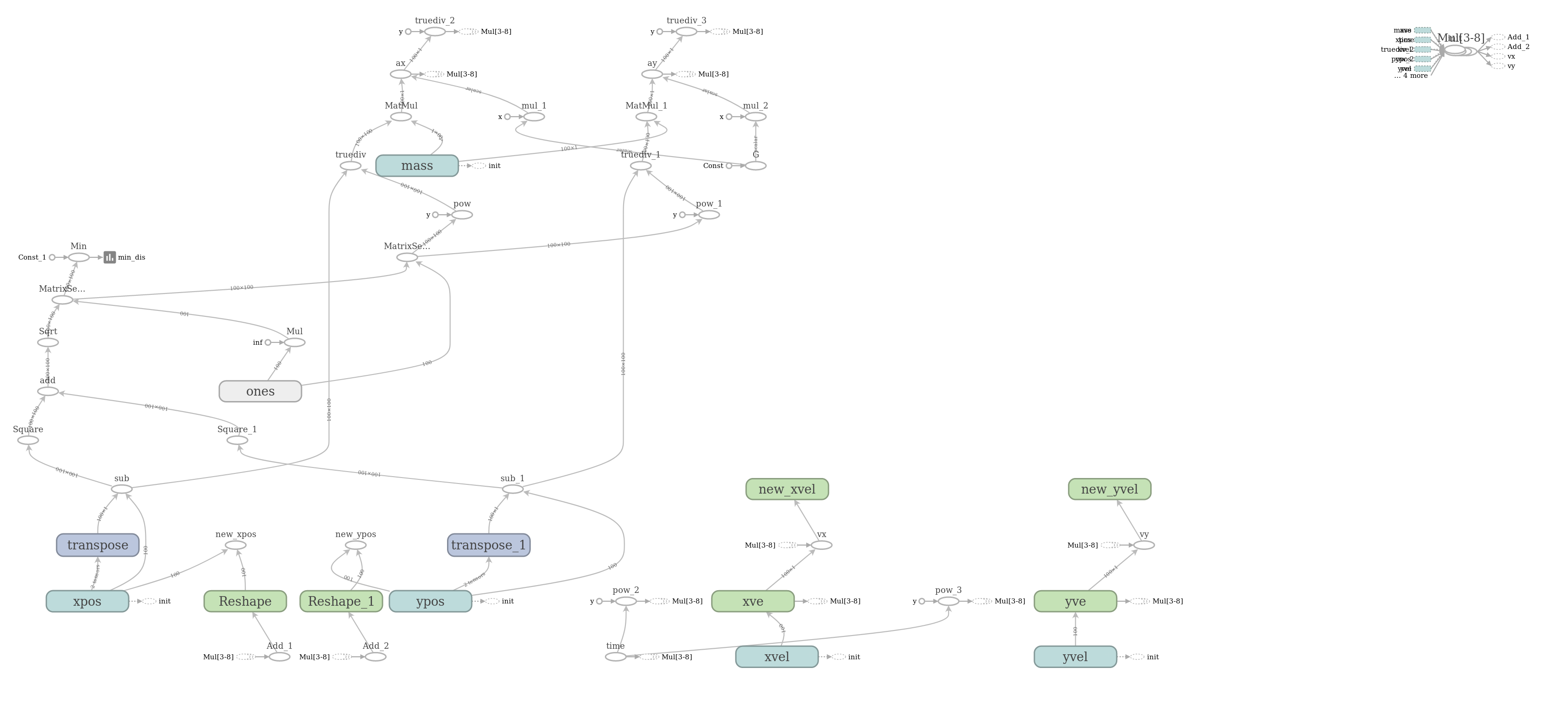
2. Compare performance of code written using tensorflow with normal python code
Normal python code took 28 sec while computational model tensorflow code took only 2 sec to run. Both codes ran for 330 iterations until termination.
Task 3 : Layer API - A Simple Neural network
codes are available [here][task3]
Given two image data-sets, we were required to use code a Layer API to build a fully-connected neural network, in order to classify the images.
We were successfully able to code the required API by using Python Library Numpy. No other curated neural networks library like TensorFlow, Keras or PyTorch were used. We constructed two major classes :
- Layer Class : This class is used to design individual layers of the neural network. Using this class the user can decide the activation functions and the dropout probability.
- Model Class : This class is used to tune the entire network as a whole. Using this class, the user can decide the Optimizer, the learning rate, the number of maximum iterations.
The various specifications provided in the Layers API :
- Activation Functions : Sigmoid, Rectified Linear Unit, tanh, Softmax.
- Regularization : Inverted Dropout.
- Optimizer : Gradient Descent, Gradient Descent with Momentum, RMS Prop, Adagrad and Adam.
- Loss Function : Cross-entropy.